
Reference & Resources
- Updated 2/4/2026
- Download
Resources
For each unit, you will need the Participant Workbook, the Facilitator’s Guide, and slide presentation. Some units also require additional materials available on the unit pages.
For this training, you will need the following resources available from our partners:
Abortion Care Guideline
The objective of this guideline is to present the complete set of all WHO recommendations and best practice statements relating to abortion. While legal, regulatory, policy and service-delivery contexts may vary from country to country, the recommendations and best practices described in this document aim to enable evidence-based decision-making with respect to quality abortion care.
Abortion pills in first 12 weeks since last period: mifepristone and misoprostol in the cheek
This two-page material provides simple instructions for safely using abortion with pills and is intended as a resource for health providers to share with their patients.
Abortion pills in first 12 weeks since last period: mifepristone and misoprostol under the tongue
This two-page material provides simple instructions for safely using abortion with pills and is intended as a resource for health providers to share with their patients.
Abortion pills in first 12 weeks since last period: misoprostol in the cheek
This two-page material provides simple instructions for safely using abortion with pills and is intended as a resource for health providers to share with their patients.
Abortion pills in first 12 weeks since last period: misoprostol under the tongue
This two-page material provides simple instructions for safely using abortion with pills and is intended as a resource for health providers to share with their patients.
- “Pregnancy Dating and Labs Resource” (see page 17) from Clinical Practice Handbook for Safe Abortion (WHO, 2014)
- Video*: Manual Vacuum Aspiration Technique Using the Ipas MVA Plus® Aspirator and Ipas EasyGrip® Cannulae
*You will need a password to access the second video. This video was adapted by Ipas with permission from Innovating Education in Reproductive Health. It is for classroom training use only. For access password, please contact info.iawg@wrcommission.org or training@ipas.org. Please do not distribute the video, video link, or password to participants.
Additionally, in 2022 Ipas released a series of abortion care videos that are helpful for this training. The videos are available here: https://www.ipas.org/resource/abortion-care-videos/#abortion-care-videos-for-health-worker
- Ipas Medical abortion calculator: www.ipas.org/resource/ma-en/
- Ipas MVA calculator: www.ipas.org/supplycalculators/mva
- Medical Abortion Commodities Database at www.medab.org
References
Before teaching the course, facilitators are advised to review the following resources:
Effective Training in Reproductive Health: Course Design and Delivery
This manual is designed to be a resource for individuals who provide training in reproductive health, whether they work with healthcare providers, managers, advocates, or community members. It is designed to help these individuals strengthen their training and facilitation skills, enabling them to plan and implement more effective training courses and events.
Abortion Attitude Transformation: A values clarification toolkit for humanitarian audiences
Ipas produced this toolkit for humanitarian audiences to explore their values, attitudes and knowledge related to abortion—with the goal of helping close the service-delivery gap in abortion care.
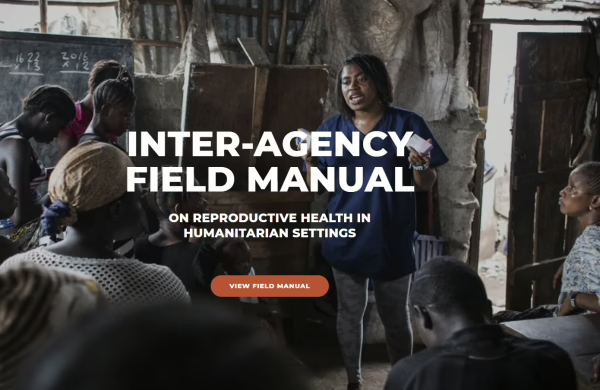
2018 Inter-Agency Field Manual (IAFM)
The 2018 Field Manual provides evidence-based information about the application and adaptation of global sexual and reproductive rights or human rights standards in humanitarian settings. Available in English, Arabic, French, and Spanish.
Training Tips for Using Pelvic Models in Manual Vacuum Aspiration (MVA) Clinical Training
This tip sheet provides basic information on the use of pelvic models for competency-based MVA training. Trainers should refer to the Ipas training curricula for in-depth training information; this guidance can also be adapted to other contexts.
Before taking the course, participants are advised to:
- Take the MISP Distance Learning Module (IAWG, 2019).
These and other publications can be downloaded at https://www.ipas.org/resources or www.iawg.net or by contacting training@ipas.org.
Feedback on the Training Materials
The IAWG Training Partnership Initiative is interested in hearing from you. Please share any questions or feedback to info.iawg@wrcommission.org regarding the training materials and their use in your context.