
References & Resources
- Updated 2/4/2026
Resources
For each unit, you will need the Participant Workbook, the Facilitator’s Guide, and a slide presentation. Some units also require additional materials available on the unit pages.
For this training, you will need the following resources available from our partners:
In Her Shoes Toolkit for Reflecting on Violence Against Women in Sub-Saharan Africa
How does the world look from another’s perspective – particularly from the view of a woman who is experiencing violence? In Her Shoes allows us to temporarily experience life as a woman experiencing violence. It is an interactive, educational exercise used in a workshop setting to help us connect to the day-to-day reality for women experiencing violence, deepen our empathy and compel us to take action.
Iraqi Refugees in Jordan: Gender-Based Violence
The Women’s Commission visits Amman, Jordan to get a snapshot of the situation for Iraqi refugee women and girls in Jordan. Many are at risk of violence enacted against them.
Violence Against Women: Strengthening the Health System Response
One in three women throughout the world will experience physical and/or sexual violence by a partner or sexual violence by a non-partner. This violence has a wide range of short- and long-term health consequences. The health system is a place where women who have experienced violence can go to in order to receive services and support for their physical and mental health needs.
Reproductive Health Kits Shelving
Instructional video for the storage after procurement of health kits.
References
Before teaching the course, facilitators are advised to familiarize themselves with the following resources and job aids:
Clinical management of rape survivors: Developing protocols for use with refugees and internally displaced persons
This guide includes detailed guidance on the clinical management of women, men and children who have been raped, taking into account available resources, materials, drugs, and national policies.
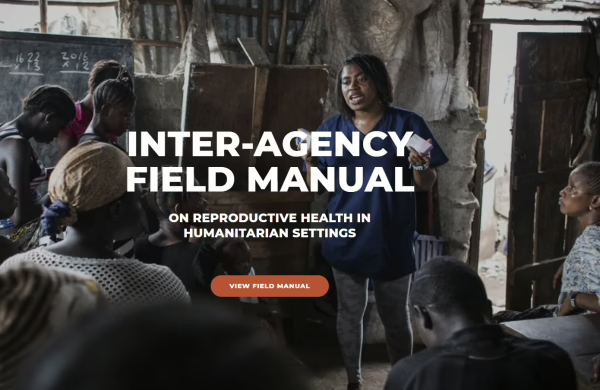
2018 Inter-Agency Field Manual (IAFM)
The 2018 Field Manual provides evidence-based information about the application and adaptation of global sexual and reproductive rights or human rights standards in humanitarian settings. Available in English, Arabic, French, and Spanish.
Gender Based Violence Quality Assurance Tool
This tool offers providers and program planners a strategy to strengthen post gender-based violence health services through evidence-based standards. It includes guidelines for the health care sector and an additional tool to support implementation.
Inter-agency Standing Committee Guidelines for Integrating GBV Interventions in Humanitarian Action 2015 (IASC GBV Guidelines)
The Guidelines support humanitarian stakeholders in protecting crisis-affected persons by: implementing GBV prevention and mitigation strategies; strengthening national and community-based systems; and aiding the recovery of communities through supporting local and national capacity.
Caring for Child Survivors of Sexual Abuse
These guidelines provide a practical approach to helping child survivors, and their families, recover and heal from the impacts of sexual abuse.
Before taking the course, participants are advised to take the MISP Distance Learning Module.
Feedback on the Training Materials
The IAWG Training Partnership Initiative is interested in hearing from you. Please share any questions or feedback to info.iawg@wrcommission.org regarding the training materials and their use in your context.