
Explore our evidence-based research and analysis
Sort By
The minimum, life-saving sexual and reproductive health needs that humanitarians must address at onset of an emergency (within 48 hours wherever possible).
These checklists provide practical advice for health staff undertaking mpox preparedness and response activities to ensure the sexual and reproductive health (SRH) needs of the population are met. It is meant to serve as a companion to the IAWG mpox and SRH in Humanitarian Operational Guidance
Social capital, the resources embedded in social networks, has been identified as a key determinant of sexual and reproductive health (SRH) outcomes, yet its role in crisis contexts, particularly in shaping access to sexual and reproductive services and influencing policy and planning, remains underexplored. This study examined the incorporation of social capital into policy and guidance documents related to women’s SRH services in humanitarian crises, specifically focusing on Fiji and the Pacific region. The findings underscore the importance of detailed guidance on leveraging existing social networks and understanding the nuanced nature of social capital and how it can impact SRH outcomes.
Refugees in two humanitarian settings in Uganda and Kenya have little access to WHO-recommended methods of abortion, and the need for safe abortion services is high. There is a lack of data on the direct experiences of abortion of those living in displacement. This study aimed to describe abortion practices, safety, and incidence in two refugee settings. These new findings come from an Elrha - R2HC funded study by Ibis Reproductive Health, Ipas, Resilience Action International, the International Rescue Committee and the African Population and Health Research Center.
This case study explored the current drivers of Maternal and Newborn Health prioritization in Somalia, a fragile country with very high maternal and neonatal mortality rates. The study found gaps in implementation of programs, and competing priorities due to insecurity and other health and social needs. Respondents highlighted a need to address fragmented accountability and oversight processes, and ensure meaningful inclusion of actors such as the private sector and the diaspora and women leaders.
Against the backdrop of a protracted conflict, northwest Syria faces significant challenges in delivering sexual and reproductive health and rights services. The conflict, which began in 2011, has severely impacted maternal and child health, women’s wellbeing, and agency. This study investigated the factors influencing family planning service accessibility in northwest Syria, considering the intricate interplay of cultural norms, beliefs, and the backdrop of armed conflict. It found that holistic strategies are needed to ensure equitable access to family planning services in northwest Syria and similar contexts globally.
This brief presents findings and recommendations generated from a Situational Analysis commissioned by UNFPA an inter-agency regional consultation organized by the regional offices of UNFPA, UNICEF and WHO supported by JHU CHH and IAWG.
To better understand the readiness of countries in Eastern and Southern Africa to respond to sexual and reproductive health (SRH) needs during emergencies, partners and governments under the 2gether 4 SRHR Programme engaged in 2022 with 22 countries of the region to conduct a Minimum Initial Service Package (MISP) Readiness Assessment. This policy brief summarizes some of the findings of the assessment and provides key considerations to help strengthen the capacity to provide MISP and SRH services in emergency settings.
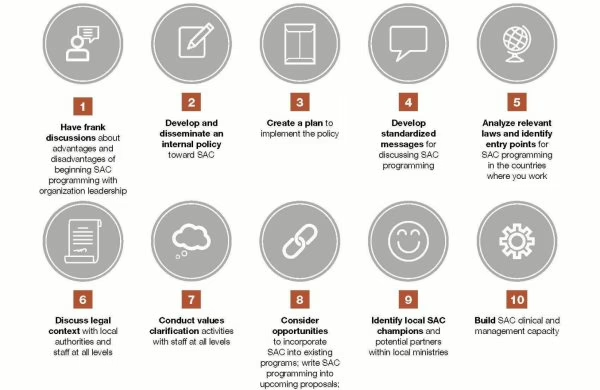
Safe abortion care (SAC) was one of the major gaps identified in the 2014 IAWG global evaluation. The IAWG SAC Sub-Working Group conducted a study of IAWG member agencies to inform efforts and support agencies to start or expand SAC activities. These 10 steps summarize the best practices for initiating SAC programming.
This one-pager lists the four guiding principles followed by the IAWG Safe Abortion Care Sub-Working Group.
The EQUAL research consortium is working to generate evidence on effective approaches to deliver life-saving maternal and newborn health (MNH) care in countries affected by conflict including in the Democratic Republic of Congo (DRC), Nigeria, Somalia, and South Sudan. These are also four countries experiencing among the poorest MNH outcomes worldwide. This information has been documented in four MNH Country profiles which will be updated annually.
Neonatal hypothermia is a major cause of preventable morbidity and mortality, especially among the world’s poorest newborns. A heat-producing wrap is necessary when kangaroo mother care (KMC) is insufficient or unavailable, yet there is little published research on such wraps. The Dream Warmer is a wrap designed to complement KMC and has been extensively studied in formal research settings but not in real-world conditions. This research found that the Warmer raised no safety concerns and was used correctly in the vast majority of cases. Healthcare providers and parents reported a generally positive experience with the Warmer.
Become a Member
Sexual and reproductive health is a core component of primary health care, but is often forgotten or ignored. Become a member of IAWG and join our efforts to ensure access to high-quality sexual and reproductive health care for people affected by crises.