
References & Resources
- Updated 2/12/2026
- Download
Resources
For each unit, you will need the Participant Workbook, the Facilitator’s Guide, and a slide presentation. Some units also require additional materials available on the unit pages.
For this training, you will need the following resources available from our partners:
Checklist for Monitoring Implementation of the Minimum Initial Service Package (MISP) for Sexual and Reproductive Health (SRH)
The reproductive health officer implements the Minimum Initial Service Package (MISP) for Sexual and Reproductive Health (SRH) checklist to monitor service provision in each humanitarian setting. This document is available in English and French for your use and reference.
Respectful Care: a Tool for Healthcare Workers
Supported by the USAID-funded Health Policy Project, White Ribbon Alliance (WRA) and Medical Aid Films (MAF) have worked together to create this animation on Respectful Maternity Care (RMC) to prepare healthcare workers in Africa to treat their patients respectfully, according to the seven points of the RMC Charter.
Bleeding After Birth
All birthing parents lose some blood after birth. Some, however, lose too much blood. This video will show how to recognize when a patient is bleeding too much, and how to give first care for the three main causes: a soft uterus, tissue left inside the uterus and tears.
Inserting an IV
This film shows how to insert an IV into the tiny vein of a newborn. It illustrates gathering supplies, finding a good vein, applying a tourniquet, the insertion technique, taping and splinting the IV, and administering medication.
References
Before teaching the course, facilitators are advised to familiarize themselves with the following resources and job aids:
Helping Babies Breathe Second Edition Facilitator Flip Chart
Provides an overview of updates made to each of the HBB 2nd Edition materials – Action Plan, Facilitator Flip Chart, and Provider Guide – that clearly delineates the changes between HBB 1st Edition and HBB 2nd Edition.
Helping Babies Survive
Helping Babies Survive is a growing suite of evidence-based, hands-on programs developed to reduce neonatal mortality in resource-limited environments. Programs are supported and implemented by many global partners including the US Agency for International Development (USAID), Save the Children, Laerdal Global Health, Latter-day Saint Charities, and Johnson & Johnson. Together, the HBS programs address the three most common causes of preventable neonatal deaths: complications during childbirth, complications from preterm birth, and neonatal infections.
2018 Inter-Agency Field Manual (IAFM)
The 2018 Field Manual provides evidence-based information about the application and adaptation of global sexual and reproductive rights or human rights standards in humanitarian settings. Available in English, Arabic, French, and Spanish.
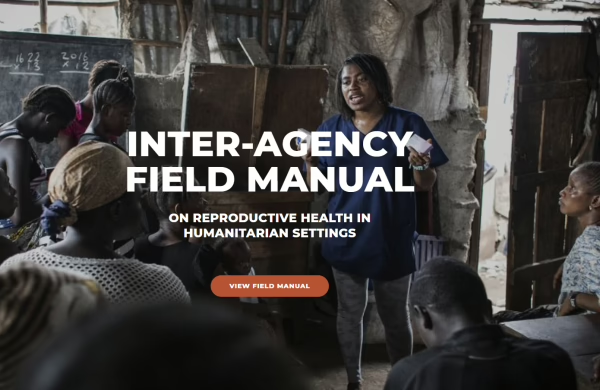
Manual: Newborn Care Supply Kits for Humanitarian Settings
To complement the RH Kits, which do not provide the full range of supplies, equipment and drugs to support implementation of priority newborn care services, the Newborn Supply Kits for Humanitarian Settings (Newborn Kits) were developed.
Newborn Health in Humanitarian Settings Field Guide
This Field Guide is a companion to the Inter-Agency Field Manual on Reproductive Health in Humanitarian Settings (2018), providing information related specifically to newborn care during the neonatal period (days 0-28 of life). It has been designed as an enhancement to national strategies and programs aimed at improving the lives of newborns and their mothers, and to strategies such as the Every Newborn Action Plan (ENAP).
Before taking the course, participants are advised to take the MISP Distance Learning Module.
Feedback on the Training Materials
The IAWG Training Partnership Initiative is interested in hearing from you. Please share any questions or feedback to info.iawg@wrcommission.org regarding the training materials and their use in your context.