
Unit 2: Core Concepts: Gender-Based Violence
- Updated 7/16/2021
- Download
Overview
This unit explains the link between gender-based violence and violations of human rights, describes the guiding principles for working with survivors of sexual violence, and examines how social norms can affect survivors’ ability to seek help and access care.
Objectives
By the end of this unit, participants will:
- Explain the link between gender-based violence and violations of human rights.
- Define gender-based violence.
- Describe the guiding principles for working with survivors of sexual violence.
- Increase awareness of and empathy for the difficulties survivors who experience violence face when seeing support.
- Highlight how social norms can affect survivors’ ability to seek help and access care, including special populations.*
- Encourage participants to consider what they can do as providers to provide an empathetic response to survivors of sexual violence.
- Critically reflect on participants’ own perceptions and beliefs that may affect the quality of care survivors receive, including members of special populations.*
*For this training, the term “special populations” should be read to refer to groups who are excluded or marginalized based on their identities or characteristics, including but not limited to lesbian, gay, bisexual, transgender, queer, intersex, and asexual (LGBTQIA) people; adolescents; persons living with disabilities; sex workers; and religious or ethnic minorities.
Timing & Methodology
Total: 270 minutes (4 hours, 30 minutes)
- 20 minutes: Video and Group Discussion
- 40 minutes: Facilitator Presentation and Video
- 90 minutes: Group Activity: In Her Shoes
- 60 minutes: Group Activity: Blanketed by Blame
- 60 minutes: Values Clarification Activity: Vote with Your Feet
Preparation
- Print, download, and gather materials
- Update the slide presentation with:
- Any existing statistics regarding sexual violence prevalence in the context of the region on slide 8
- Add the legal definition of rape in the setting on slide 20
- Flip chart: Draw a blank GBV tree (see example in the Facilitator’s Guide)
- Prepare the following activities:
- In Her Shoes
- Blanket by Blame
- Vote with your Feet Values Clarification
Resources Available Online
- Refer to the Facilitator’s Guide for the detailed session guide and list of materials needed for this unit
- Presentation
- Participant Workbook
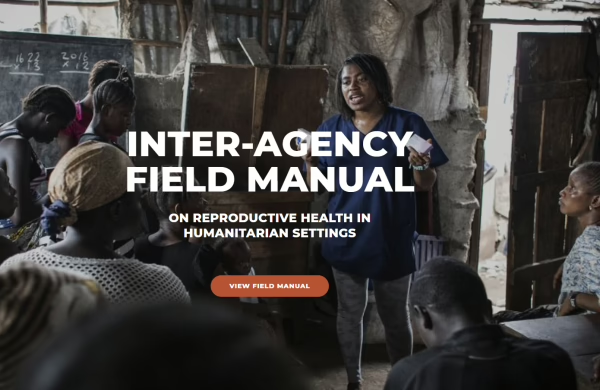
2018 Inter-Agency Field Manual (IAFM)
The 2018 Field Manual provides evidence-based information about the application and adaptation of global sexual and reproductive rights or human rights standards in humanitarian settings. Available in English, Arabic, French, and Spanish.
In Her Shoes Toolkit for Reflecting on Violence Against Women in Sub-Saharan Africa
How does the world look from another’s perspective – particularly from the view of a woman who is experiencing violence? In Her Shoes allows us to temporarily experience life as a woman experiencing violence. It is an interactive, educational exercise used in a workshop setting to help us connect to the day-to-day reality for women experiencing violence, deepen our empathy and compel us to take action.
Blanketed by Blame: Facilitator’s Handout for the Clinical Management of Sexual Violence Survivors in Crisis Settings S-CORT
The Blanketed in Blame activity provides an important opportunity to explore how social norms and discrimination affect sexual violence survivors’ abilities to seek help and access care. It also encourages participants to consider what they can do to provide an empathetic response to survivors of violence.
Iraqi Refugees in Jordan: Gender-Based Violence
The Women’s Commission visits Amman, Jordan to get a snapshot of the situation for Iraqi refugee women and girls in Jordan. Many are at risk of violence enacted against them.
Violence Against Women: Strengthening the Health System Response
One in three women throughout the world will experience physical and/or sexual violence by a partner or sexual violence by a non-partner. This violence has a wide range of short- and long-term health consequences. The health system is a place where women who have experienced violence can go to in order to receive services and support for their physical and mental health needs.